The team of the socio-pedagogical program ‘Formula of Unity’ is organizing an international camp for teenagers aged 14–18.
You can find the history of our camps here.
Attention! The camp will happen entirely in English (so a language proficiency level of at least A2–B1 is required). Currently we expect participants from Russia, Ecuador, Cameroon, and Turkey however students from other countries are more than welcome to join.
General Information about the Camp
Daily Camp Schedule
The first half of the day is educational, it is dedicated to classes on certain subjects. Participants can choose one of the following:
A class is opened if at least 4 people sign up for it. Therefore, we ask you to choose two preferred classes: your first and second priority. If the first priority class does not get enough participants, you will be invited to join your second-priority class.
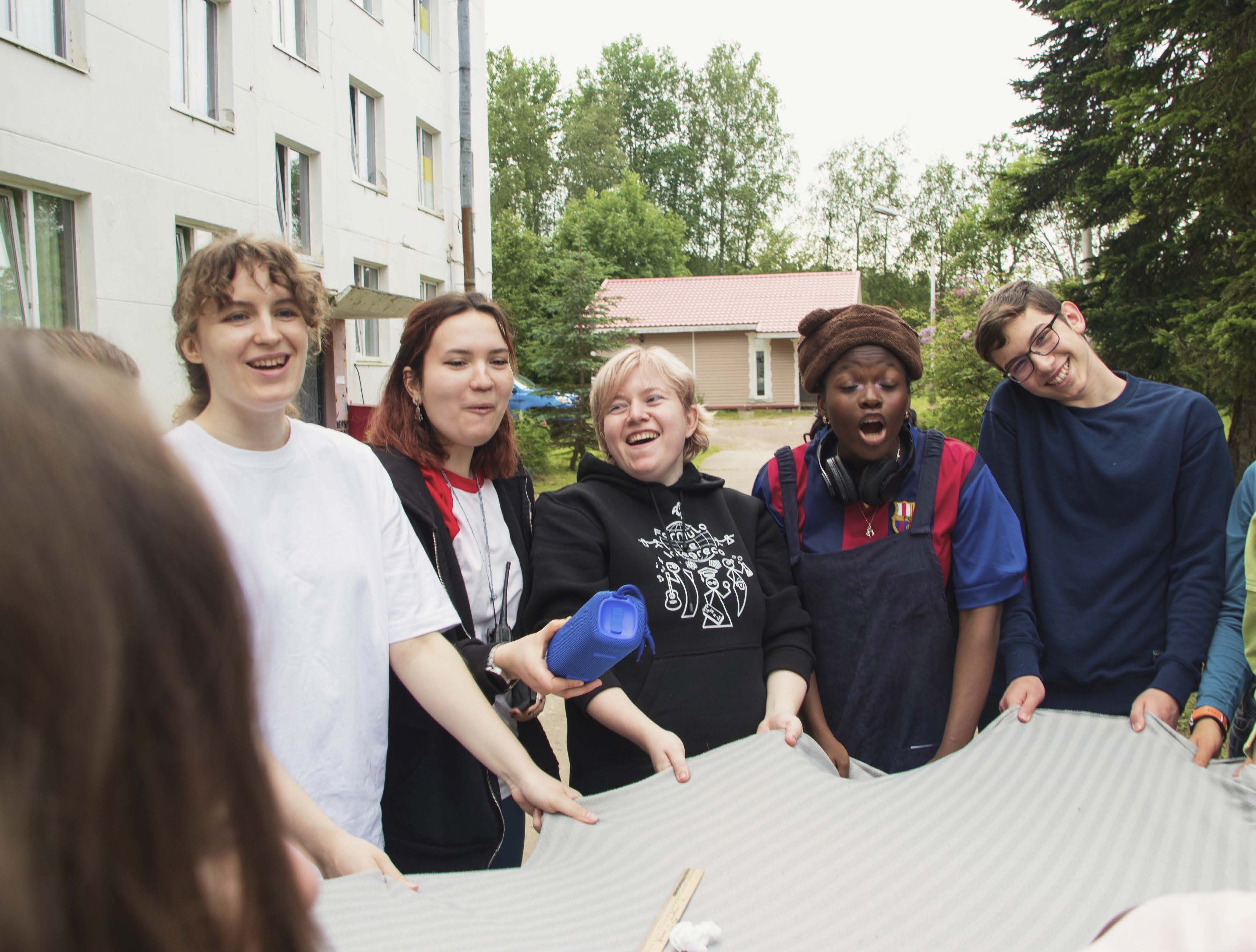
We spend the second half of the day according to the Methodology of Collective Creative Education — the day is filled with events we create together. This is also an important part of the day, during which students develop such skills as responsibility, leadership, teamwork, negotiation, mutual understanding, finding win-win solutions, critical thinking as well as organizing and running events. The educators will help with resolving various issues. They carefully observe group dynamics and address emerging conflicts, managing the group’s interactions.
In the evening, each group has an ‘Evening Light’ gathering, where participants discuss meaningful things (for example there we get to know each other, take part in creative activities, and discuss topics that are important to the participants).The camp’s atmosphere helps teenagers open up, form friendships and develop mutual respect. You can read more about our approach here.
This time, the camp will be about a dialogue of cultures. We will exchange cultural practices, explore our similarities and differences, and find common interests for communication beyond the camp. On the last day, a large festival is planned, it will be prepared by the participants and invited educators.
After the camp, we plan to host Zoom meetings once a month to allow participants and educators to meet again, stay in touch, and share stories about their countries.
Camp’s Participation Fee
Registration for the camp
Registration takes place in your Personal Account:
Contact information
Socio, 8–11 grade
On the Sociotechnician profile we will try to understand what society is and how an ordinary person can influence it.
The big world around us is full with challenges. Most certainly there are issues that disturb you personally but you feel like there is nothing you can do about that. Many people think that all that remains for us is to accept it and leave it alone. But there are those who decide to change the world around them. It can be a small “world”: a group of friends, a circle of like-minded people. Or there can be communities and even entire movements to implement widescale changes.
That is the core of sociotechnics: by uniting, people can change the environment around them. Special technologies have been developed for this — social technologies. They provide answers to the questions:
- How to gather like-minded people?
- How to resolve conflicts?
- Why do some ideas spread everywhere, while others disappear?
- How to create new ways of living?
- How to take into account global civilization trends in our everyday life?
- How to raise resources for a non-profit project?
…And much more. During the camp, we will get acquainted with these tools and understand how to apply them to real life situations.
But you won’t be able to rebuild the environment if you don’t learn to change yourself! Therefore, a significant part of the course will be dedicated to learning tools for self-development, self-determination, and self-management.
Of course there will be a lot of discussions. We will discuss what is happening in the world, consider existing trends and social problems. When we start talking about the transformation of social reality, different people will have different positions on what this “change for the better” means. So we shall also discuss our ideas for better society and what the very concept of “better” means.
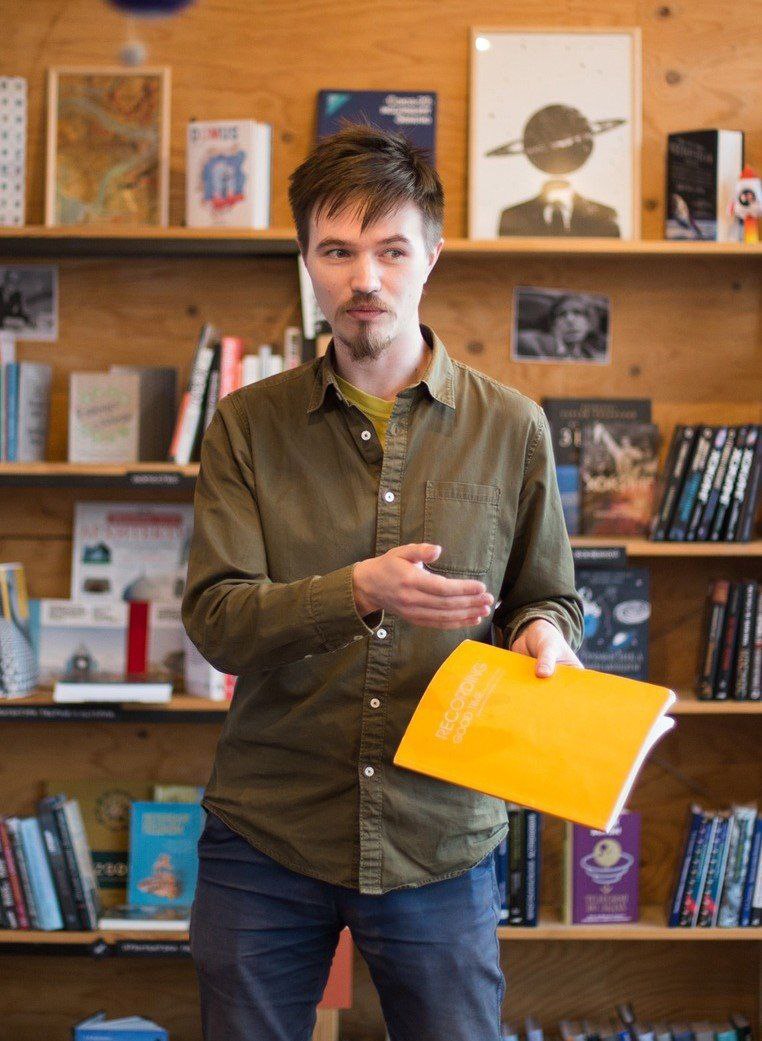
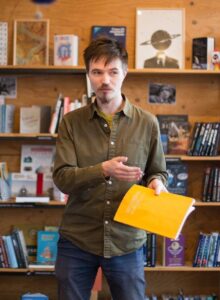
Teacher: Alexey Doilnitsyn (Io). Philosopher and practitioner in developing educational communities.
Critical Thinking, 8–11 grade
“The important thing is not to stop questioning. Curiosity has its own reason for existing.”
Albert Einstein.
Our brain is the world’s data-processing centre — the only tool that lets us understand not just ourselves, but also how the world around us works. You’d think such a complex organ should function flawlessly. But it doesn’t: the brain makes plenty of logical (and not so logical) mistakes, rooted in the very nature of our thinking.
On top of that, different people perceive the world differently — and all because there’s sometimes too much information around, and sometimes too little.
So how do we look at the world objectively, not subjectively? Why do we tend to make mistakes even when we’re sure we’re right? How can you tell if your opinion is being manipulated?
In this module, we’ll explore how our thinking works, study the main mistakes in how we perceive information, and learn the laws of logic. We’ll also talk about manipulation in argumentation and how to handle yourself skilfully in a debate with an opponent.
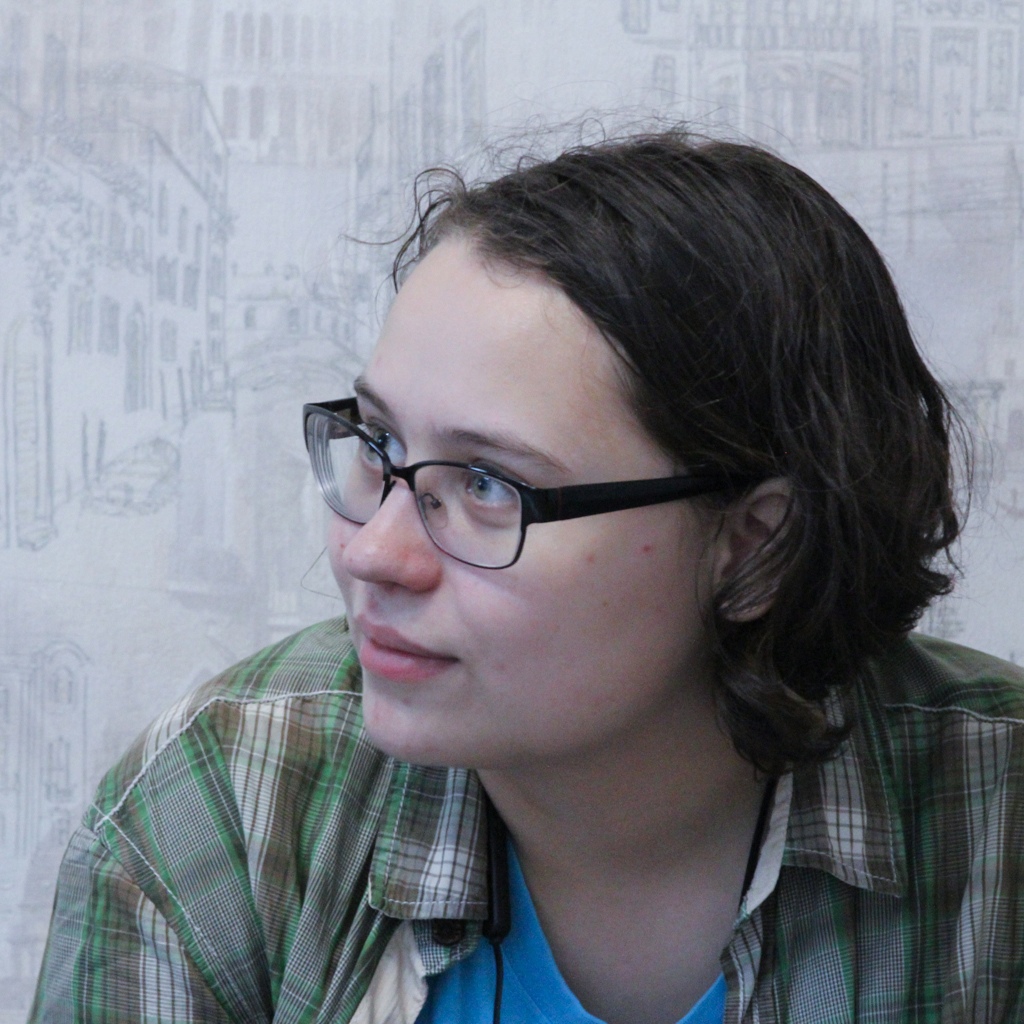
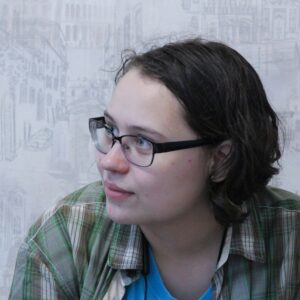
Teacher: Anastasia Plotnikova (Thais) — game-based educator, student at the National Social and Pedagogical College (АНПОО НСПК), majoring in Elementary School Teaching; completed the course “Critical Thinking in Educational Activities” from the Association of Russian Trainers (ART); Yandex Crowd employee.
Maths
The mathematics course in this round of our camp will be based around two components. One is expanding on familiar school-related topics such that the students will be able to live through the process of encountering a new problem, learning the concepts behind it, offering their own ideas and finally tackling the problem as well as proposing other solutions and generalisations. For an aspiring mathematician, this process is in itself self-rewarding, for students specialising in other areas but looking to focus on maths at our camp, this will be a great experience of looking at ideas taught in school from a new angle, as well as exploring your own creativity and potential. The other component will involve a more entertaining and informal section of problems built around logic and lateral thinking.
Goals:
- To revisit some school-taught concepts and see how students from different cultural and educational backgrounds have slightly different interpretations of the same ideas
- To learn to solve problems and understand central facts in topics listed below
- To grow in soft skills during class discussions and problem solving
- Find a favourite maths problem that will keep you wanting to handle it even after class is finished
Proposed topics (may be modified):
- Numbers: types of numbers and arithmetic operations, different notations and methods in different countries. Properties of integers. The idea of a mathematical proof. Proving some mental arithmetic tricks and properties. Prime numbers, divisibility. Using algebra to solve problems about integers. Introduction to different bases and their uses in IT. More proofs and “open-type” questions in Maths.
- Algebra: Formulae, algebraic expressions and their meaning. Polynomials. Equations and quadratic equations. Deriving related theorems and formulae. Graphing quadratic functions. Geometric and physical proofs of quadratic functions: connecting algebra and geometry.
- Geometry: Ideas of area and volume, an intuitive approach to how they can be calculated or one formula can be derived from one another. “Mass method” as a means of looking at geometric shapes as physical objects. Different countries place different emphases on geometry and this will be discussed.
- Logic and algorithms. Cooperative winning strategies in logical problems, where the solution relies on the decision of many people who share a common goal (such as pirates splitting a treasure on certain conditions, each with their own personal interest). Logic problems as mathematical problems which require understanding of context and trial-and-error, rather than explicit knowledge. Some situations mentioned in problems are to be acted out by the students themselves : )
The course will end with an informal but ‘proper’ exam/quiz which will require being able to put forward and apply from scratch a handful of the problems discussed during the two weeks.
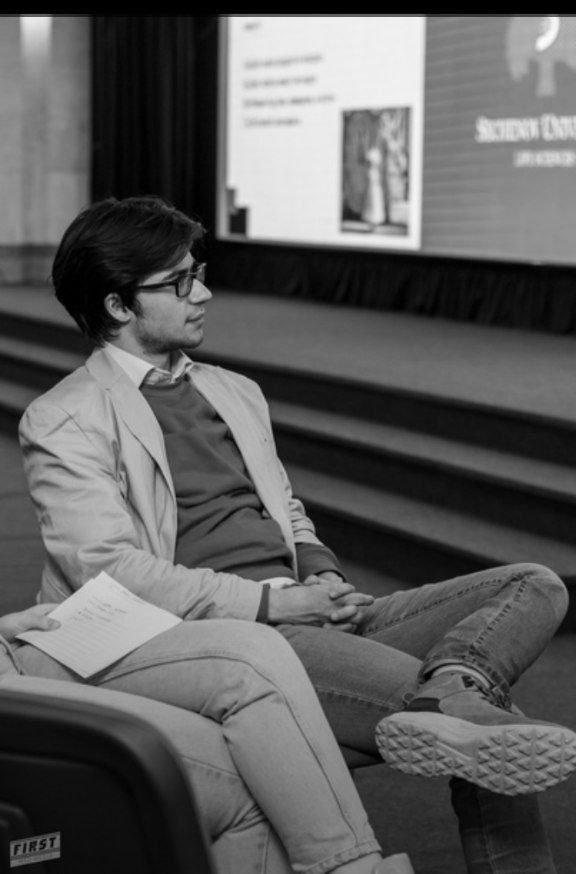
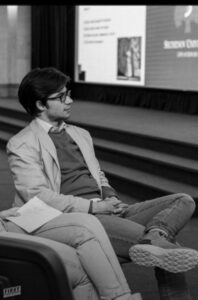
Teacher: Filipp Grinev (Moscow), teacher at ‘Two Times Two Laboratory,’ education consultant and event organiser with interests in mathematical modelling in sports science. (Education: Moscow First Medical State University [Sechenov University], Mechanics and mathematical modeling [in medicine], ~BSc)

Psychology, 5–11 grade
The human brain is very complex, and we still don’t know a lot about it. You’ll be able to try being a psychologist, a client and you’ll even be able to understand what your pet thinks and why Napoleon decided to conquer the world. Our course has some theory, but, most importantly, it is full of practice. You can learn to read body language, to deal with difficult situations, to understand yourself and others better. There is even some time to analyze music, paintings and movies from the psychological standpoint.
During the classes we will cover the main topics that will help us understand it better:
- You will learn about different psychological approaches, how phycology has developed in different countries. We’ll compare our everyday psychological experience with our foreign colleagues.
- We’ll analyse the way the human psyche works from the biological point of view too. A part of our lessons will be dedicated to neuroscience.
- Learning about clinical psychology and psychiatry, we will study the mechanisms of formation of pathologies, various neurological diseases, and try to diagnose patients. Some of the psychological techniques that we will study can help us better understand not only others, but also ourselves. Emotions, feelings, relationships, conflicts.
The classes will have theoretical sections, but the most important is the practical part. There will be different lesson formats, including a secret group project in collaboration with our musicians.
There are no age limits for people who want to sign up for my classes :) If you took a psychology course in school and plan to participate here, you will learn a lot of new information too, because mostly I will use university level materials. And my courses don’t repeat themselves so if you have already been at my classes you’ll still learn a lot of new stuff.
I will be very glad to see you there!
Teacher: Andrade Samarina Karolina, Bachelor, Institute of Special Education and Rehabilitation of the Herzen State Pedagogical University.




 Details














 Email
Email


 VKontakte